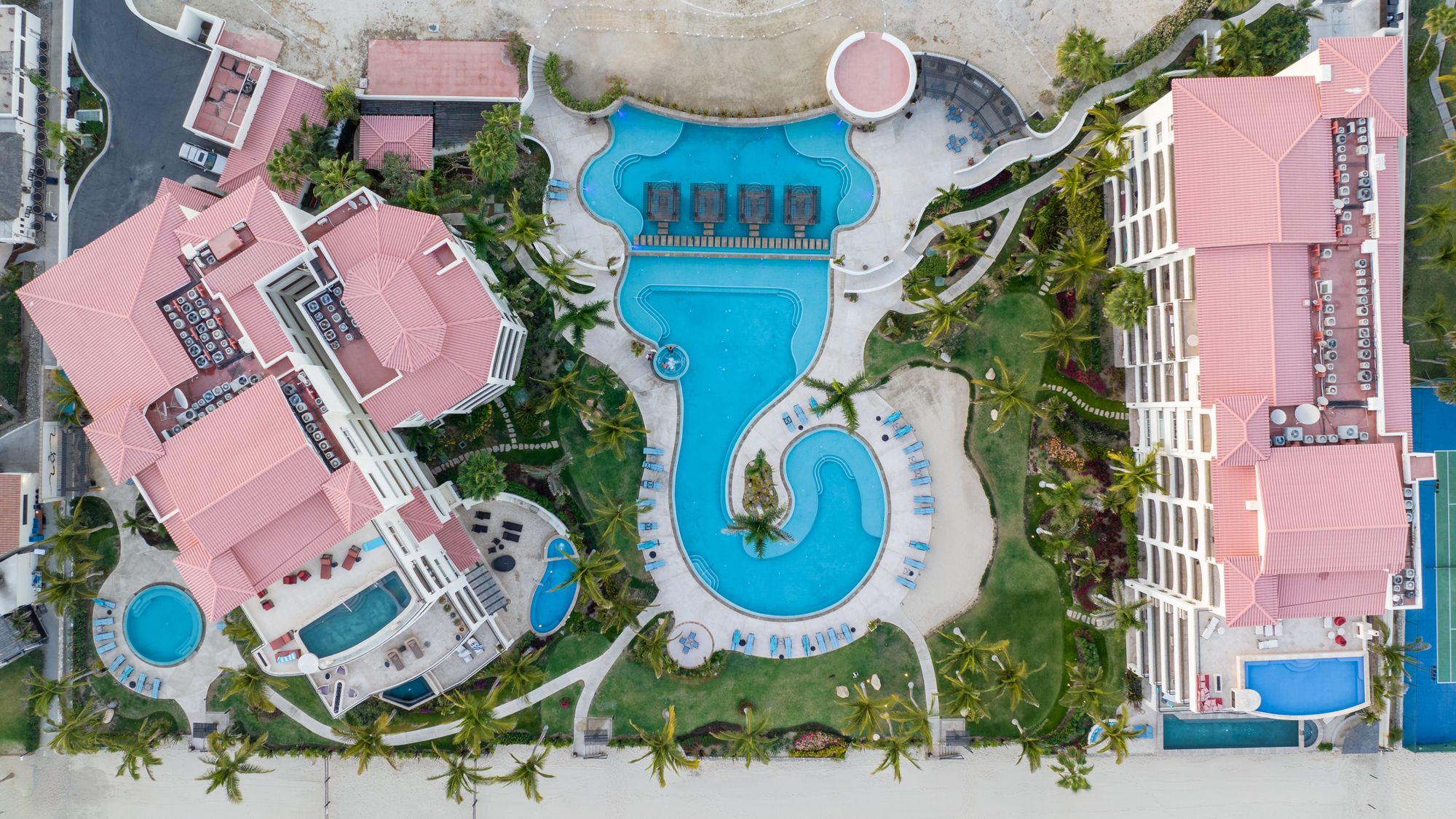
Mai Khao and Nai Yang are Phuket’s quietest beaches and the smallest foreign-buyer market on the island. Both sit at the northern end, adjacent to Phuket International Airport, with Sirinat National Park protecting most of the beachfront from intensive commercial development. The protected status keeps density low and prices high, but limits the foreign-buyer market activity to a small set of premium resort developments.
This article covers what’s there, who it fits, and who it doesn’t.
Where are Mai Khao and Nai Yang in Phuket?
Mai Khao and Nai Yang are Phuket’s northernmost beaches, immediately adjacent to Phuket International Airport, both largely within Sirinat National Park. Mai Khao Beach runs roughly 11 km along Phuket’s northwest coast — the longest beach on the island. It sits north of the airport runway, with planes coming in low over the southern end (a regular tourist attraction).
Nai Yang Beach is the smaller curved bay immediately south of the airport. Less commercial than Mai Khao, similarly protected. Sirinat National Park headquarters is in this area.
Distances:
- Phuket International Airport: 0–5 km, 5–15 min (closest area to airport)
- Bang Tao / Cherngtalay: ~10–15 km, ~20–25 min south
- Phuket Town: ~25 km, ~35–40 min
- Patong: ~25 km, ~40–50 min
The airport proximity is both a feature (frequent flyers) and a drawback (some flight noise, especially Mai Khao south end).
What’s it like to live in Mai Khao and Nai Yang?
Mai Khao and Nai Yang are quiet, low-density, beach-focused, with a lifestyle set by the resorts rather than a town centre. Sirinat National Park protection means:
- Beachfront commercial development is restricted — no Bangla Road equivalent, no dense restaurant strip
- Limited new construction on the beach itself
- Sea turtles nest at Mai Khao in season (November–February) — environmentally significant
- Casuarina-tree shade along much of the beach, providing the open natural feel that Patong/Karon have lost
The lifestyle is fundamentally different from west-coast tourism areas:
- No nightlife to speak of
- Resort-driven dining (the major hotels — Anantara, JW Marriott, Renaissance, Sala — host most of the area’s restaurants)
- Quieter day-time atmosphere even in high season
- More European and Australian retiree presence than Russian/Chinese tourist concentration
For owners wanting genuinely quiet Phuket, Mai Khao and Nai Yang are the cleanest choice on the island.
What day-to-day services are near Mai Khao and Nai Yang?
Almost none inside the area itself — groceries, hospitals and schools all mean a drive. The day-to-day services come from outside the area:
- Supermarkets: Big C and Tesco/Lotus’s at the Thalang cluster (~15 min south) or in Cherngtalay (~20 min)
- Hospitals: Bangkok Hospital Phuket (~35 min), Bangkok Hospital Siriroj (~35 min) — both in Phuket Town
- Schools: no major international school in the area; commute to UWC Thailand (~25 min) or BISP (~35 min)
For occasional-use owners, the limited internal infrastructure is fine — drive to Bang Tao or Thalang for what you need. For daily-use residents, it’s a real friction.
What properties are for sale in Mai Khao and Nai Yang?
Foreign-buyer property here is concentrated around a handful of premium resort and branded-residence developments, not a broad open market:
Mai Khao:
- Anantara Mai Khao — luxury resort with branded residences
- Sala Phuket Resort — boutique luxury, smaller scale
- JW Marriott Phuket — large luxury resort with some residential inventory
- Renaissance Phuket — newer addition
Nai Yang:
- Smaller scale; some condotel and resort-residence inventory
- Less developed than Mai Khao
What do villas cost in Mai Khao and Nai Yang?
Pricing sits in the premium-to-ultra-prime band — branded resort residences and pool villas in the surrounding cluster, reflecting the scarcity created by limited buildable land under Sirinat National Park protection. The market is small, inventory turnover is low, and resale takes longer than mainstream Phuket. Specific numbers move with the market — get current pricelists from a Phuket-resident agent for any specific project. For the current asking-price trend from active listings, see Mai Khao property prices and Nai Yang property prices; for the island-wide picture, see the Phuket quarterly property market report.
What rental yields do Mai Khao villas achieve?
Resort programs set the return in Mai Khao and Nai Yang, not an open rental market. Most rental inventory is part of resort hotel-pool structures (Anantara, Sala, JW Marriott) operating under the resort’s hotel license — fully legal — so an owner receives what the pool’s terms pay out rather than an area average. Independent rental activity is small because the buyer pool is small.
Headline percentages from agencies and developers are claims, not measurements; Rental yields in Phuket — what investors actually earn covers what the cost stack does to them.
The Hotel Act (Short-term rental in Thailand — Hotel Act 2004 reality and Phuket enforcement) exposure for non-licensed buildings exists here as elsewhere; the practical impact is smaller because most independent inventory is small and less visible.
What are the pros and cons of buying in Mai Khao or Nai Yang?
Mai Khao and Nai Yang trade the quietest beaches on the island for the smallest, slowest market and the least day-to-day infrastructure.
Pros
- Quietest beaches in Phuket
- National park protection limits future development density
- Closest area to the airport — frequent flyers benefit
- Premium branded-residence options for buyers wanting that specific ecosystem
- Sea turtle nesting and natural environment — genuine appeal for nature-focused owners
- Lower density of construction than Bang Tao
Cons
- Smallest foreign-buyer market depth in Phuket
- Resale takes longer
- Limited day-to-day infrastructure — drive 15–25 min for shopping
- No major international school in the area
- Some flight noise, especially Mai Khao south end
- Less restaurant variety than west-coast tourism areas
- Branded inventory typically has mandatory rental program restrictions
- Capital appreciation depends on scarcity, not transaction volume
Is Mai Khao or Nai Yang a good area in Phuket for retirees?
For a retiree who wants quiet over daily services underfoot, Mai Khao and Nai Yang can fit — the area already draws more European and Australian retirees than tourist traffic, and Sirinat National Park keeps it calm and low-density. It might not be the right fit for a retiree who wants groceries and a clinic nearby: supermarkets are 15–20 minutes south in Thalang or Cherngtalay, and the nearest hospitals, Bangkok Hospital Phuket and Bangkok Hospital Siriroj, are both about 35 minutes away in Phuket Town. A retiree who drives comfortably and prioritizes quiet over walkability is the fit; one who wants services on foot is better served elsewhere on the island.
Who is Mai Khao / Nai Yang right for?
Mai Khao and Nai Yang are right for buyers who want the quietest lifestyle on the island and don’t need it to be an investment thesis.
1. Branded-residence buyers committed to the resort ecosystem. Anantara, Sala, JW Marriott loyal buyers who specifically want this resort’s inventory.
2. Frequent flyers using Phuket as a base. The airport proximity is unmatched; the “quick drive to the gate” lifestyle is real.
3. Quiet-vacation owners. People who want Phuket beach without Phuket density. Occasional use, no school-age children, no daily restaurant lifestyle requirement.
4. Nature-focused buyers. Sea turtles, casuarina pines, low-density beaches — for owners who value these specifically.
Who should not buy in Mai Khao or Nai Yang?
Mai Khao and Nai Yang might not be the right fit for buyers who need daily infrastructure, school access, resale liquidity, or a diversified appreciation thesis.
Daily-use residents — the infrastructure isn’t there.
Families with school-age children — too far from schools.
Buyers prioritizing resale liquidity — the market is thin.
Restaurant/lifestyle-density seekers — Bang Tao or Surin are dramatically better.
Capital-appreciation-focused investors — Layan and Kamala have outperformed in 2024–2025; Mai Khao appreciation is slower and depends on scarcity, not market dynamics.
Is Mai Khao or Nai Yang in Phuket a good investment area?
Mai Khao and Nai Yang have the smallest foreign-buyer market depth in Phuket, and capital appreciation there is driven by scarcity — Sirinat National Park limits new supply — rather than by transaction volume or a diversified investment thesis. Three rules specific to Mai Khao / Nai Yang:
-
Buy here for the lifestyle, not the investment thesis. The market is small and slow. The case for buying is the area’s specific quiet character, not its yield or appreciation profile.
-
For branded-residence buyers, evaluate the resort’s specific operator quality. Anantara, Sala, JW Marriott have different operational standards. The branded ecosystem is what you’re buying — make sure the operator delivers what you want.
-
Don’t expect quick resale. The market is thin; time-on-market is longer than mainstream Phuket. Plan multi-year hold horizons.
For broader Phuket context: Buying property in Phuket — complete guide for foreign buyers and Phuket districts overview — every area compared for foreign property buyers. Adjacent areas: Bang Tao and Cherngtalay area guide — one of Phuket's deepest property markets (the next-door bigger market). For ownership and investment context: Foreign property ownership in Thailand — what you can and cannot own and Rental yields in Phuket — what investors actually earn.



.jpg?width=2000)